
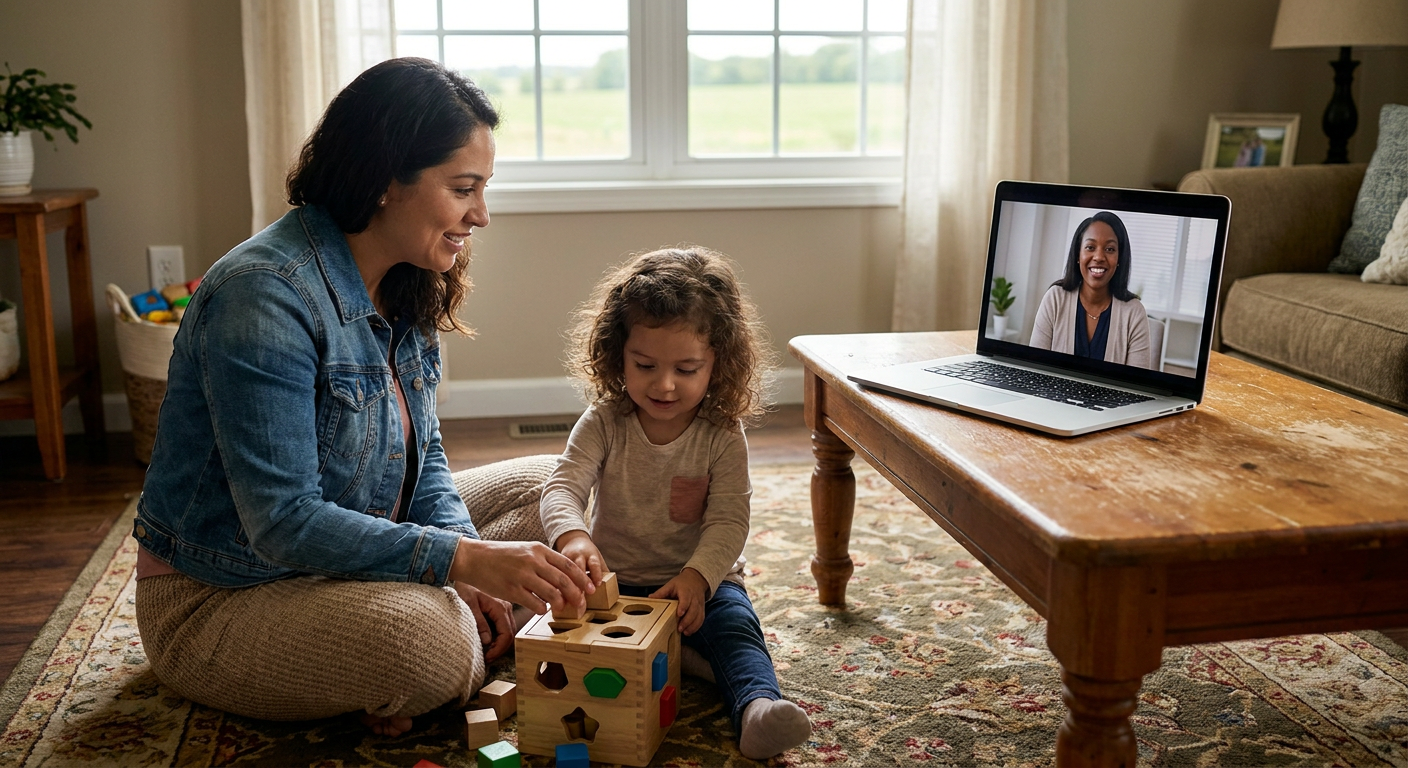



If you are looking into telehealth ABA therapy in Missouri, you are probably not just asking whether virtual sessions exist. You are trying to figure out whether this kind of support could actually work for your child and your family, especially when long drives, limited provider options, school schedules, and work demands already make life feel full.
For many families in rural Missouri, telehealth can remove some of the biggest barriers to getting consistent support. It can make care easier to access and easier to keep going. Still, it is not the right fit for every child, every goal, or every stage of care.
This guide is here to help you think through that decision in a practical way. It focuses on what telehealth ABA can look like in real life, when it may be a strong fit, and when hybrid or in-person care may make more sense. If you want a broader foundation first, this overview of ABA therapy is a helpful place to start.
Why Telehealth ABA Can Be a Practical Option for Rural Missouri Families
Families in rural Missouri often have to solve several problems at once. The nearest clinic may be far away. In-home providers may be hard to find. Parents may be balancing work, other children, and school transportation while trying to keep support consistent. In that setting, telehealth can ease some of the pressure by cutting down travel and making it easier to build services into everyday family life.
That can matter in different ways depending on the child’s age and goals. For younger children, telehealth often works best when the clinician is coaching a parent or caregiver through routines that already happen at home, like transitions, play, meals, or communication practice. For school-age children, telehealth may offer more flexibility around school schedules while still supporting goals that can be coached in the home setting.
At the same time, better access does not automatically mean better fit. Telehealth can remove friction, but the format still has to match the child’s needs, the family’s capacity, and the kind of support that will be most useful. If you want more context on how family involvement helps skills carry over between sessions, this article on parent training in ABA is worth reading.
What Telehealth ABA Looks Like in Everyday Family Life
Telehealth ABA is often more hands-on than families expect. A session may include live observation, caregiver coaching, modeling, problem-solving around home routines, progress review, and discussion of what to practice between visits. Sometimes the clinician is working mostly through the caregiver. In other cases, especially with school-age children who can engage on screen, the child may participate more directly while the caregiver stays involved.
In real life, that could mean getting coaching during a difficult after-school transition, talking through communication strategies during meals, working on smoother homework routines, or adjusting how adults respond to behaviors that keep disrupting the day. For toddlers and very young children, telehealth is often less about asking the child to sit through a virtual session and more about helping adults use strategies during familiar routines. For older children, there may be more direct practice alongside caregiver support, depending on the child’s communication style, goals, and screen tolerance.
Before starting, it helps to be realistic about what the format needs. Families usually need a reliable device, a workable internet connection, a camera setup that lets the clinician see what is happening, and an adult who can join consistently. Telehealth is also not a replacement for school, and it is not always the best option when a child needs extensive hands-on prompting, has significant safety concerns, or finds virtual interaction especially hard. If you want a little more background, this guide to what a typical ABA session can look like can help fill in the picture.
A Simple Way to Think About Fit: The PAIR From Anywhere Framework
A useful way to evaluate telehealth is to look beyond availability and ask whether it is likely to be helpful and sustainable for your family. The PAIR From Anywhere Framework can help with that.
Practical access reality
Start with the problem telehealth is meant to solve. If your biggest challenge is long travel time, missed work, limited transportation, or very few nearby providers, telehealth may make support easier to start and easier to maintain. In some cases, that makes it a bridge while a family waits for more local options. In others, it may be the format that works best over time because support is happening in the home where daily routines already unfold.
Adult support capacity
Telehealth usually works best when there is enough adult availability to make the format workable. That does not mean a caregiver has to be free all day or do everything alone. It means someone needs to be able to join sessions, learn strategies, help with prompting when needed, and carry those strategies into daily life. The family’s real circumstances matter here, including work schedules, siblings in the home, internet reliability, and how easy or hard it is to create a reasonably calm space for a session. If you want a closer look at this role, this piece on parent coaching at home offers useful insight.
Intervention fit
The next question is whether telehealth fits the child’s current goals. It may be a strong fit for observation, caregiver coaching, communication support, routines-based problem-solving, and some behavior goals that can be worked on in the home. It may be less effective when a child needs a lot of direct physical prompting, has complex safety concerns, or cannot engage enough for the format to be productive. For younger children, telehealth often works best when the focus is coaching adults within everyday routines. For school-age children, it may be more effective when they can participate directly while still getting caregiver support.
Review and next-step plan
Once telehealth begins, it helps to keep checking whether it is doing what your family needs it to do. Useful signs to watch include session consistency, caregiver confidence, the child’s engagement, and whether goals are moving forward in a meaningful way. If progress feels stalled, participation is becoming difficult, or the child’s needs change, it may be time to ask about hybrid services, different intensity, or a different setting. The best fit now may not be the best fit later.
When Telehealth May Work Well, and When Another Format May Be Better
Telehealth can be a strong fit when travel is a major burden, provider options are limited, and the most important goals can be coached within home routines. It can also help families maintain consistency during seasons when in-person scheduling is hard to keep up with. For early intervention, this format can be especially useful when adults are available to use strategies throughout the week rather than relying only on what happens during the session itself.
Hybrid or in-person care may be a better fit when a child needs more hands-on teaching, has trouble engaging through a screen, or has needs that are difficult to address virtually. School-age children may also benefit from hybrid planning when support needs to connect more directly across settings, including school-related routines.
No single format is best in every situation. The better question is which format matches the child’s goals, the family’s routine, and the level of support needed right now. When you start comparing providers, it can help to ask direct questions about how fit is evaluated and what would lead the team to recommend a different format. This checklist of questions to ask before hiring an ABA provider can help guide that conversation.
Questions Missouri Families Should Ask Before Choosing a Telehealth ABA Provider
For families in Missouri, many of the most important questions are practical before they are clinical. Ask whether the provider can legally and operationally serve your area, how scheduling works for rural families, and what technology expectations apply if internet service where you live can be inconsistent.
It also helps to ask how the provider handles insurance verification. Families should confirm whether the provider is in network, whether any telehealth-related requirements apply, and how ABA benefits are verified under a commercial plan or MO HealthNet when relevant. If insurance feels confusing, this guide to ABA insurance coverage and how to get help offers a useful overview of the questions to bring to both the provider and the payer.
Finally, ask what happens if telehealth alone is not enough. A strong provider should be able to explain how progress is monitored, what signs suggest the format needs to change, and what next steps may be recommended if virtual care is not meeting the child’s needs.
Telehealth vs. In-Home vs. Center-Based ABA for Rural Families
Use this comparison to move from Could telehealth work? to Which format should we ask about first?
| Decision area | Telehealth | In-home | Center-based |
| Travel burden | Lowest travel demand for families in remote areas | Less travel for the family, but provider travel can affect availability | Highest family travel demand when the clinic is far away |
| Access speed / wait time | May improve access when local providers are limited | Depends on staffing in the area | Depends on clinic openings and distance |
| Caregiver involvement required | Usually high, especially for younger children | Moderate to high depending on goals | Varies, often lower during direct sessions but still important overall |
| Best-fit goals and skills | Coaching, routines-based support, communication, and problem-solving in the home | Direct support in home routines and everyday environments | Structured teaching, clinic-based programming, and possible peer exposure |
| Technology / home setup needs | Requires reliable internet, a device, and workable camera visibility | Minimal technology needs | Minimal technology needs for treatment |
| School coordination | Can work well around school schedules and home routines | May support home-school carryover | Often requires more travel and schedule planning |
| Privacy / distraction concerns | Needs a home setup with manageable distractions | Home distractions still matter | More controlled setting, fewer home distractions |
| Insurance and benefits questions | Ask whether telehealth ABA is covered and how it is authorized | Ask about availability in your area and any benefit limits | Ask about clinic coverage, frequency, and transportation burden |
| Child tolerance for the format | Best when the child or caregiver can engage consistently through the format | Better for children needing direct in-person interaction at home | Better for children who benefit from a structured clinical setting |
| When hybrid care may make more sense | When telehealth improves access but does not cover every goal | When home support is useful but some clinic or school coordination is still needed | When structured direct care is primary but family coaching still matters |
Questions to ask before deciding: Which goals are a good match for telehealth, what caregiver role do you expect during sessions, how will progress be measured, and what would make you recommend hybrid or in-person support instead?
FAQ
Is telehealth ABA effective for children in rural areas?
It can be, especially when the goals fit the format, the caregiver can participate, and the child can engage consistently enough for coaching to carry into daily routines. The biggest question is not whether telehealth is universally effective. It is whether it is the right fit for your child and your family right now.
Can telehealth ABA replace in-person therapy?
Sometimes it can meet a family’s needs well, especially when caregiver coaching in the home is the main priority. In other situations, hybrid or in-person care may be the better choice because the child needs more direct support, more hands-on teaching, or a different setting.
What technology do families need for telehealth ABA sessions?
Most families need a reliable internet connection, a phone, tablet, or computer with working audio and video, and a setup where the clinician can see and hear what is happening clearly enough to coach effectively. Privacy and distraction levels also matter.
Does insurance cover telehealth ABA in Missouri?
Coverage can vary by plan, payer rules, and how services are billed. Families should confirm coverage directly with both the provider and the insurance company, including any telehealth-specific requirements and any MO HealthNet questions that apply to their situation.
What should parents ask a telehealth ABA provider before getting started?
Ask which goals are a good fit for telehealth, how much caregiver participation is expected, how progress will be measured, what the session setup should look like, and what happens if telehealth is not enough. For a broader checklist, this guide on what to ask an ABA provider is a strong next step.
Choosing an ABA format is rarely about finding one answer that works for every family. It is about finding the right pairing between your child’s needs, your daily reality, and the kind of support that can help your family move forward together.